On the matters such as the overview of business and financial information in the Annual Securities Report, the management identifies significant risks that may materially affect investors making decisions. Two significant risks described below are: “business risks,” which are risks associated with the business, and “operational risks,” which are other risks that may affect our entire Group. The forward-looking statements in the report are based on the judgment of the Group as of the end of the current fiscal year.
The Group promotes risk management for significant risks under the risk management system specified in the “basic policy on internal control.”
Business execution departments manage “business risks,” and special function departments manage “operational risks.” To monitor risks globally, we appoint regional managers for each major overseas geographic region to develop a regional monitoring function.
Each responsible department manages risk information and provides reports at the Corporate Strategy Meeting every month. The Meeting members, joined by Directors and Vice Presidents, deliberate the risk information. The results of the deliberations are immediately instructed to each responsible department, which promptly implements measures, strengthens controls. Eventually, those are reported back again to the Corporate Strategy Meeting with respective actions and remediation status, making the group’s risk management more effective.
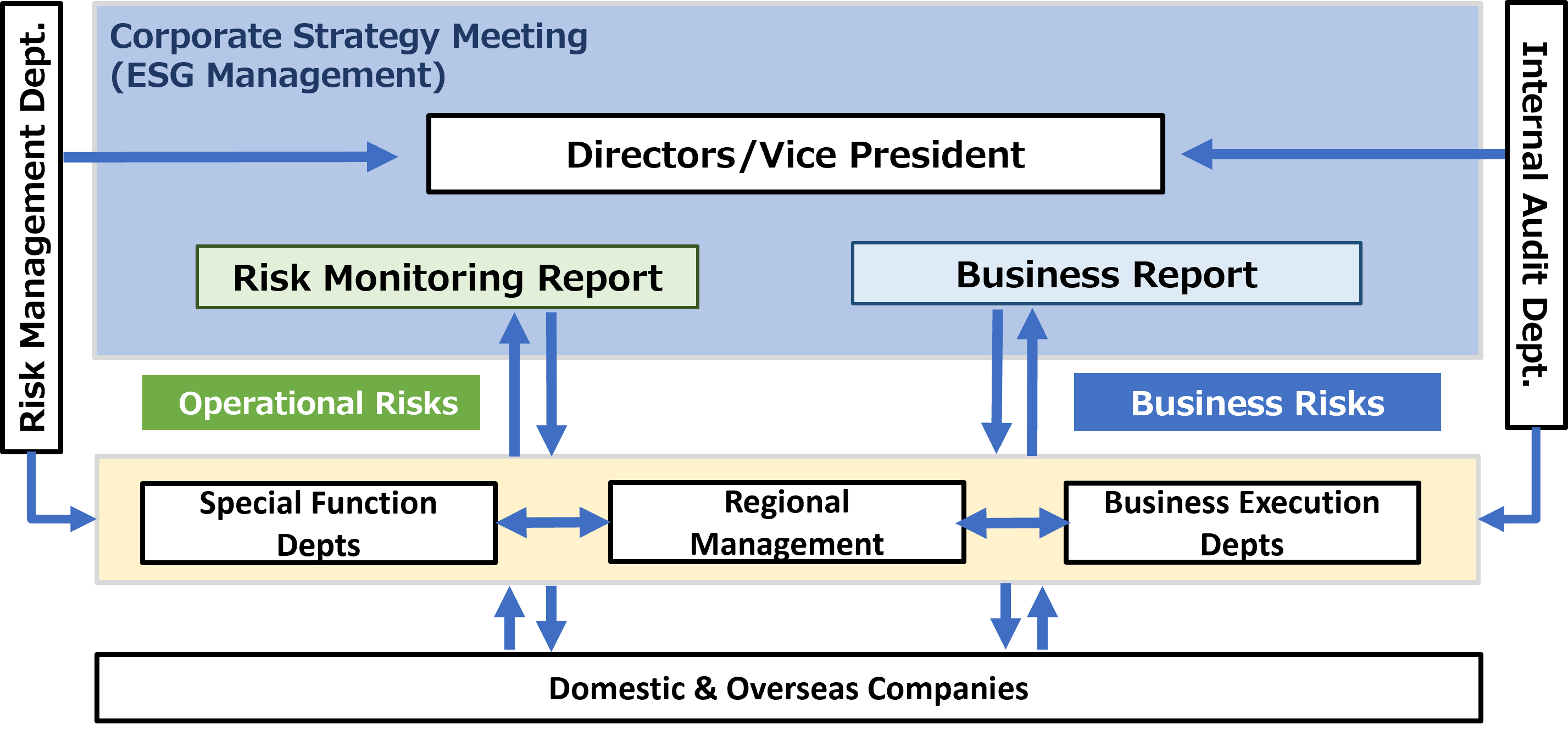
The major risks in the current fiscal year, in addition to the remaining risks since the previous fiscal year, were selected by the officer in charge of risk management and the department in charge of risk management after gathering opinions from Directors, departments in charge, the audit firm, analyzing the agenda and deliberation topics at the Board of Directors and the Corporate Strategy Meeting, and deliberating at the Corporate Strategy Meeting.
We considered the relative significance of respective risks by categorizing in the following chart with two axes: the vertical axis showing the “impact” on the businesses when such risks arise and surface, and the horizontal axis showing the “probability” of the occurrence.
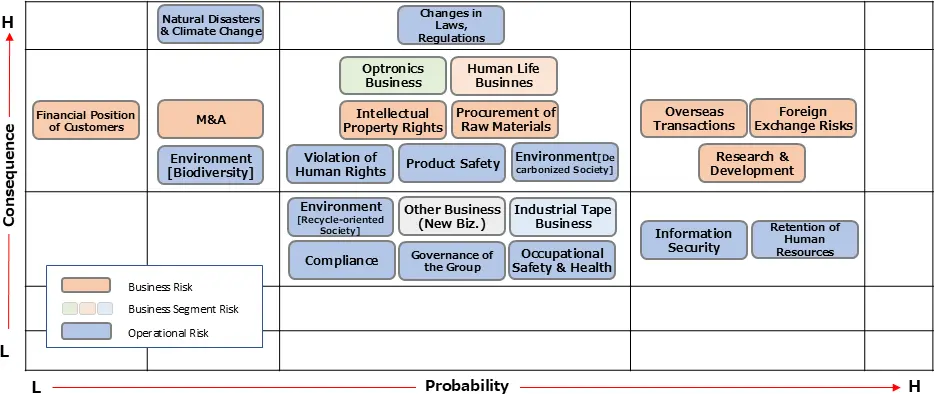
At the end of the fiscal year, those risks (business and operational risks) are self-assessed by the responsible departments, and independently evaluated by the department and the officer in charge of risk management, based on the assessment criteria, such as implementation systems, the implementation of controls and measures, and the occurrence of and response to incidents, etc.
The results are reported to the Corporate Strategy Meeting and the Board of Directors.
The assessment result below indicates a change in risk from the beginning to the end of the fiscal year.
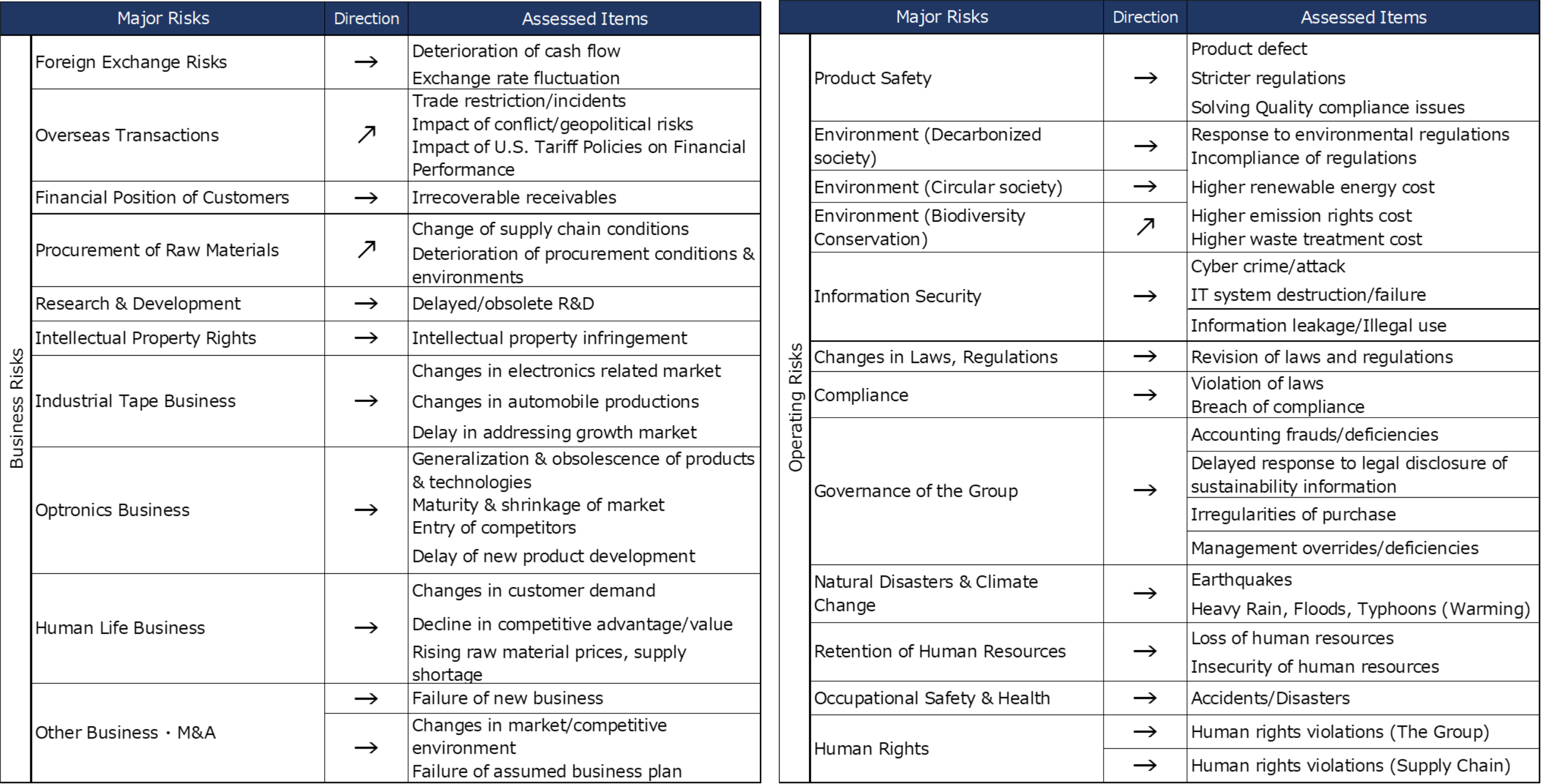
*The arrow indicates the change in risk from the beginning of the period
(↗: Increase in risk, →: No change, ↘: Decrease in risk)
| Foreign Exchange Risks |
| Related Materiality: - |
| The Group operates a global business, with more than 80% of total sales revenue earned outside Japan. The majority of trade activities such as export and import are conducted in US dollars.
The Group’s performance may be adversely affected by abrupt changes in the global economy triggered by events such as international disputes, including armed conflicts or outbreaks of infectious diseases. Furthermore, the Group’s performance may be adversely affected by unexpected exchange rates, volatility in equity and interest rates, financial instability, the rise of protectionism such as the U.S. tariff policy, and trade restrictions for the sake of national security. Besides conducting timely monitoring of the Group’s internal fund balance, financing situation, asset and liability by currency, etc., the Group has established financial control centers in each region and is working to consolidate funds and hedge foreign exchange risks, among other measures, thereby reducing financial and foreign exchange risks. |
| Overseas Transactions |
| Related Materiality: Enhancing compliance, Maintaining stable product supply |
| The Group operates a global business, with more than 80% of total sales revenue earned outside Japan, and about 40 subsidiaries and affiliates conduct trade activities such as export and import.
Accordingly, in the various countries where we operate, there are risks such as import/export controls, interruption of electric power supply and transportation services, rising labor costs, deterioration of employment relationships, labor disputes, and risks arising by prolonged lead times caused by cyberterrorism and environmental issues. Moreover, the Group’s performance may be adversely affected by the international logistics disruptions due to the armed conflicts in the Middle East and the Strait of Hormuz blockade, etc., which have caused sharp rises in shipping costs and standing cargos brought by constraints on transportation capacities, and shipping delays, etc. The Group manages distribution by increasing risk visibility in the supply chain and establishing a BCP (business continuity plan) for distribution to strengthen the supply chain. |
| Financial Position of Customers |
| Related Materiality: - |
| Serious financial problems could develop at some customers from whom the Group holds accounts receivable due to major changes in their operating environment.
Should such receivables become irrecoverable at any one of its largest customers in the fast-changing electronics and life science sectors, the amount to be written off could be enormous, which in turn could negatively affect the performance of the Group. The Group has established Credit Control Group and makes it a rule to closely investigate the financial positions of its customers before starting a business. The Group has also purchased credit insurance to mitigate risks. |
| Procurement of Raw Materials |
| Related Materiality: Maintaining stable product supply |
| The Group procures petroleum-derived raw materials.
If the supply of raw materials were to decrease or be disrupted due to deteriorating situations and disruptions caused by the armed conflicts in the Middle East and the Strait of Hormuz blockade, etc., along with damage from natural disasters or accidents, the supply-demand balance could be disturbed, resulting in failure to procure necessary raw materials or an increase in costs. Any of these contingencies could influence the performance of the Group. The Group endeavors to reduce the risks involved in securing a sufficient supply of key raw materials through measures including sourcing materials from multiple suppliers and setting and managing inventory levels for a given period of time. We have launched the Supply Chain Committee with a cross-sectional team that aims for sustainable procurement in the supply chain. We have been addressing the risks involved in the upstream supply chain by visualizing geopolitical risks and risks related to chemical substance regulations, which have been increasing in recent years. During the current fiscal year, we established the Committee as a permanent structure within the Procurement Business Division and are working to further strengthen the supply chain. |
| Research and Development |
| Related Materiality: Creating PlanetFlags™/HumanFlags™ |
| The industry in which we operate our business experiences turbulent market changes that are not easy to predict.
New technologies or products from other companies can suddenly and unexpectedly cause our products to become obsolete. Situations like this can impact our future financial results. In order not to be influenced by trends in a given business, the Group works on R&D to develop new technologies and products focusing on the Sanshin (“three new”) Activities, which is to stimulate demand through the development of new applications and new products, as well as make relevant equipment investments. Furthermore, in accordance with the Group policies that place ESG at the center of management, we are concentrating our resources on themes which can be the options for our proprietary PlanetFlags™/HumanFlags™. We also practice rigorous intellectual property management to protect such products by creating barriers to entry. |
| Intellectual Property Rights |
| Related Materiality: Creating PlanetFlags™/HumanFlags™, Enhancing compliance |
| The Group owns, maintains, and manages a large amount of intellectual property rights for the purpose of enhancing its market competitiveness.
However, it is possible that a third party could claim that such rights are invalid, or such rights could be inadequately protected, imitated, or involved in litigation in some regions. Should the protection afforded by intellectual property rights be seriously lost, the performance of the Group may be adversely affected. The Group’s Technology and IP Strategy Division and business divisions work together to pay due attention to the intellectual property rights of other companies to ensure the Group does not infringe upon them while at the same time pursuing initiatives to uncover any products on the market that infringe upon the Group’s intellectual property rights. |
Business risks in each operating segment are as follows:
| Industrial Tape Business |
| Related Materiality: All Materialities |
| The Group globally supplies a diverse range of Functional Base Products to a broad range of industries, including its three focus domains of Information Device & Display, Semiconductor & Electronics Component, and Mobility. In each domain, customers are increasingly seeking products with high added value.
In the Information Device & Display and Semiconductor & Electronics Component sectors, markets change rapidly and we are in fierce competition with domestic and international competitors. Any changes in those markets may affect our performance. By creating Global Niche Top™ products and Area Niche Top™ products under our Niche Top Strategy and Sanshin Activities initiatives, we are working to create PlanetFlags™/HumanFlags™ products as new axes for growth and to advance the transformation of our portfolio coupled with the structural reform while developing a business constitution that is resilient to market forces. Furthermore, by understanding our customers’ processes and offering a lineup that meets their needs, we offer proposals that combine materials and facilities, thereby contributing to our customers’ productivity improvement. In Mobility, we offer adhesive materials for the automobile structure and sealing materials for airtight and waterproofing applications in the global market, and fluctuations in automobile production volumes due to factors similar to those of the electronics and semiconductor markets can therefore impact our financial results. By pushing expansion into growth areas such as EVs (electric vehicles) and CASE (Connected, Autonomous, Sharing/Service, and Electric) and working to add to our existing business by capturing new business in growth areas, we are, also in this sector, working to create a business constitution that is resilient to market forces. As part of our efforts in growth areas, we are strengthening collaboration among the Group companies and working to provide a wide range of product lines. As geopolitical tensions rise in the Middle East and logistical concerns intensify around the Strait of Hormuz, our performance may be affected by rising prices of raw materials such as primarily crude oil and petrochemical products and a deteriorating logistics environment. We plan to continue diversifying our raw material suppliers and properly reviewing our sales prices. |
| Optronics Business |
| Related Materiality: All Materialities |
| A major market for the Information Fine Materials sector is the display industry, which is rapidly changing and is exposed to fierce competition from a number of companies. The commoditization of products and technologies in which the Group’s components are incorporated, a decline in sales revenue due to market maturation, and pressure on profit margins due to the entry of competitors may negatively affect the Group’s performance. If higher tariffs are imposed on products related to the display sector due to changes in the U.S. tariff policy, or if rapidly growing demand for AI causes shortages of semiconductors and soaring semiconductor prices, trends in sales of these products and the supply chain could be affected. Price hikes and an unstable supply of materials affected by geopolitical risks, as manifested in the Strait of Hormuz blockade, and environmental regulations may also affect the Group’s production and supply of products.
We immediately identify the evolving needs of our customers, the leader of the display industry, and continue to develop and launch new products built on our technology. We also expand markets for our products by accelerating product launches in non-display markets. In addition, to prepare for the various changes in the external environment, we implement BCP measures for our business, such as ensuring stable procurement, diversifying our production locations, and promoting digital transformation and data-driven management. In the circuit materials business, we are focusing our efforts on markets and products that support a data-driven society/smart society and are anticipated to grow and supply products with high market share. The Group’s performance may be temporarily affected if our product supply experiences the impacts of soaring raw material prices and power costs caused by continued inflation worldwide, changes in investment trends of data center associated with growing demand for generative AI services, growing geopolitical risks such as the Strait of Hormuz blockade, and changing international situations such as trends in trade policies of various countries. Furthermore, even if market growth continues over the medium and long term, if we are unable to establish a stable product supply system and fulfill our supply responsibilities in line with demand trends, it may affect our future business performance. To manage these risks, we are working to secure production capacity to flexibly adapt to demand fluctuations by establishing a manufacturing backup system across multiple sites, preparing a BCP for procurement of raw materials, and pursuing productivity improvement through the effective use of digital technology (automation, AI, and digital transformation). |
| Human Life Business |
| Related Materiality: All Materialities |
| The Human Life business consists of Life Science, Membrane, and Personal Care Materials businesses.
In the Life Science business, we are strengthening our initiatives as a new business field for the Group, with a focus on the oligonucleotide therapeutics business. The oligonucleotide therapeutics market is forecast to grow in the future, with a rise in the number of late-stage clinical research topics and new drug approvals. Demand for contract manufacturing of oligonucleotide therapeutics, which we undertake in the Life Science business, fluctuates according to the progress of customers’ research and development and clinical trials. Accordingly, suspension or discontinuation of customer’s clinical trials based on scientific evidence may affect our performance. If the U.S. tariff policy and/or the situation in the Middle East pushes up the prices of the raw materials we procure or makes it difficult to procure those materials, our performance may be affected. Moreover, drug discovery of oligonucleotide therapeutics in this business provides technologies to customers in the pharmaceutical industry after our research and development is advanced. Therefore, depending on the progress of our research and development of technologies with competitive advantages, which leads to the provision of value to customers, our performance may be affected accordingly. As for the contract manufacturing of oligonucleotide therapeutics, we strive to mitigate the impact of demand fluctuations by handling a wide range of research and development activities and clinical trial projects commissioned by customers. To counter the U.S. tariff policy and geopolitical risks, we are working to mitigate its impact through measures such as further pursuing cost reductions for raw materials. Meanwhile, in drug discovery of oligonucleotide therapeutics, we are steadily advancing our research and development activities, including collaborations with external organizations, to ensure both safety and efficacy. The Membrane business primarily supplies components for water processing equipments used across various industries, as well as those for wastewater treatment applications within those industries. In this business, our sales volumes and sales prices may be affected if China’s economic slowdown or declining demand causes delays in customers’ planned capital investments or intensifies price competition. Our performance may also be affected if the conflict in the Middle East worsens to disrupt the logistics network that covers the Red Sea, the Suez Canal, and the Strait of Hormuz, pushing up ocean freight rates, insurance premiums, and costs of energy. Furthermore, there is a risk that production costs at production sites in the U.S. may rise because of the U.S. tariff policy. To manage these risks, we will build on our sales in focus markets and for focus usage, expand the sales of high-value-added products, and speed up new product launches, thereby reducing the impact of price competition. We will also mitigate geopolitical risks and the impact of tariffs by optimizing suppliers, logistics routes, and production locations; properly managing our stocks; and initiating a cost pass-through as necessary. The Personal Care Materials business’ main markets are for hygiene materials and daily necessities, mostly diaper materials and label films. Demand for these products is relatively stable, yet general consumption of these products can easily be affected by global affairs or price fluctuation. These commodity markets are full of competitors as they are easy to enter, which may cause sales prices to fall, affecting our performance. Additionally, rising energy costs associated with geopolitical factors (e.g., the prolonged Russia–Ukraine war, the intensifying conflict in the Middle East), inflation-driven high prices (surging raw material costs and declining consumer spending), and the loss of business opportunities due to changes in the U.S. tariff policy, could impact our financial results. We implement a BCP measure for raw material procurement (purchasing from two companies or dispersing suppliers) to prepare to manage the risks of a raw material price hike and supply disruption. Moreover, we pursue proper capital investment and digitalization to cut costs through improved productivity. As for sales, we will remain stably in black and resilient to the impact of the external environment by expanding the sales of technologically differentiated, high-value-added products and developing environmentally friendly products. |
| Others |
| Related Materiality: All Materialities |
| The Group’s performance may be adversely affected if new businesses are not launched as planned.
The Group strives to conduct sound business operations by regularly assessing the alignment of the Group’s position with that of relevant markets and customers. |
| Others / Additional Items: M&As |
| Related Materiality: All Materialities |
| The Group engages in mergers and acquisitions, business alliances, and strategic investments as necessary when such actions provide an effective means of acquiring technologies to enhance corporate value, expand into new business areas, or accelerate business growth.
However, if the Group is unable to achieve the results or synergies that it initially envisioned due to significant changes in the market or competitive environment or if acquired businesses are unable to secure revenue as planned, there is a possibility that the Group’s performance may be affected by impairment of goodwill and fixed assets. When forming partnerships with other companies, the Group bases its decisions on due consideration of market trends, customer needs, the business conditions of the counterpart company, and competitive advantage in the market. |
| Product Safety |
| Related Materiality: Maintaining stable product supply |
| The Group manufactures and supplies intermediate materials or products to our customers according to strict quality control standards for the purpose of highest-quality manufacturing. Also, tightening regulations on chemicals such as fluorinated compounds has been demanded in recent years.
In the event of a product defect, such as a quality defect, or a violation of laws or regulations with respect to a chemical substance or quality compliance violation such as quality fraud, we will be subject to obligations for compensation for the defect or a penalty for violation of laws or regulations. We will also need to manage reputational risk posed by social media nowadays. These factors may affect our performance. The Group strives to make continuous improvements by obtaining certification of strict international quality management systems in line with those required by industry. Regarding quality compliance issues, we are strengthening hardware measures, including those related to manufacturing and inspection environments, as well as audit initiatives utilizing the “three-line defense,” while implementing training to address those issues and working on the risk assessment activities we have launched to prevent the issues. We are also considering alternative products for PFAS, which is expected to be regulated more strictly, and working to strengthen our chemical substance management system by adopting ranking management according to the voluntary management regulation for chemical substance. With regard to regulations on chemical substances, we have reinforced efforts to promote regulatory compliance throughout the industry by joining specific industry associations as part of advanced responses and obtaining regulatory information from the deliberation phase. |
| Environment (Decarbonized Society) |
| Related Materiality: Responding to climate change |
| The Group recognizes that climate change is a material issue that has a significant impact on business continuity and the sustainability of society, and so it defines “Realizing a decarbonized society” as a material issue for sustainability.
In the current fiscal year, international pressure to reduce emissions grew, the obligation to disclose emissions in Scopes 1, 2, and 3 became stronger, and increasing demand for renewable energy caused market changes. Direct and/or indirect costs of manufacturing may rise because of stricter policies and regulations, higher carbon prices, and/or increased costs of procuring renewable energy, among other factors, during the transition to decarbonization. There is also concern that we might become less competitive if we fall behind with our action for the environment, as customer companies and global markets increasingly demand performance designed for decarbonization and environmental performance. To accomplish Nitto Group Carbon Neutral 2050, we pursue lower GHG (Greenhouse Gas) emissions as one of our medium- to long-term critical themes. Besides complying with more stringent related laws and regulations, we are also working to reduce our customers’ GHG emissions through our products and solutions by reducing energy consumption and introducing renewable energy in our manufacturing processes to meet societal demands for lower GHG emissions. The Group’s targets have been validated by the SBTi (Science Based Targets initiative). We are working to cut GHG emissions across our supply chains to achieve a 46.3% reduction in Scopes 1 and 2 and a 25% reduction in Scope 3 by 2030. |
| Environment (Circular Society) |
| Related Materiality: Realizing a circular society |
| The Group defines “Realizing a circular society” as a material issue for sustainability, as resources are increasingly depleted, plastic waste makes adverse environmental impacts including marine pollution, and other global issues become severe to undermine sustainability.
If waste management companies refuse to pick up certain waste such as plastic or organic solvents or if disposal fees dramatically rise, our waste disposal may fall behind schedule, disrupting our production activities. This type of disruption may lead to suspended operation or delays in production, which may affect our performance. Moreover, falling behind on compliance with the environmental regulations that are slated to be tightened (e.g., mandatory recycling of materials, more recycling-related laws and regulations) may result in additional investments and/or confusion across supply chains. Besides ensuring compliance with relevant laws and regulations, the Group is committed to recycling plastics resources and to its efforts to advance the effective use of resources in order to realize a circular society. We have set a higher target percentage for the use of recycled plastics waste from product manufacturing and stepped up our efforts to achieve it. We have also set the percentage of resources to be put into effective use in order to efficiently harness all resources we use as part of our efforts toward the realization of a circular society. |
| Environment (Biodiversity Conservation) |
| Related Materiality: Conserving biodiversity |
| The Group defines “Conserving biodiversity” as a material issue for sustainability, as destruction of ecosystems is worsening and species are rapidly decreasing across the world.
Corporate activities rely on natural resources, yet the waste produced and chemicals used in these activities can have negative impacts on ecosystems. Therefore, we believe that it is our responsibility as a business to deliver nature-positive products designed to restore and regenerate the natural environment. If any equipment malfunction or error causes volatile organic compounds (VOC), pollutants, or hazardous substances to be released into the air or water, the surrounding area may suffer environmental pollution and ecosystems in the area may be adversely affected. In fact, the Group also recognizes the potential hazards of released VOC to a regional environment and employees’ health and defines the reduction of VOC as one of its material issues. As part of its efforts to conserve biodiversity, the Group has become a registered TNFD (Taskforce Nature-related Financial Disclosures) Adopter. Using the LEAP (Locate, Evaluate, Assess, Prepare) approach recommended by the TNFD, we disclosed information in line with the TNFD framework by tracking its reliance and impact on the natural environment in its business activities and identifying risks and opportunities. We plan to implement measures to mitigate the identified risks and increase the opportunities going forward. |
| Information Security |
| Related Materiality: Reinforcing information security |
| Information systems play a crucial role in every aspect of the Group’s business activities. On the other hand, cybercrime is becoming increasingly sophisticated, and human-caused risks such as internal fraud and negligence are also increasing.
In the event that the Group’s information systems suffer a malfunction or leakage or unauthorized use of information such as technical, customer, transaction, or personal information occurs, regardless of intent or negligence, the Group’s performance may be adversely affected. The Group implements a range of information security measures against cyberattacks from both a hardware and software perspective, including implementing multilayered protection, a rapid detection and response system, as well as providing BCP training in preparation for emergencies. Moreover, to prevent negligence such as information leakage and unauthorized use, we strive to enhance management security by educating executives and employees on the importance of information security, strictly enforcing our information management rules, such as conducting targeted e-mail attack trainings and restricting the means of taking out information. |
| ChanChanges in Laws, Regulations |
| Related Materiality: Enhancing compliance |
| The Group operates in 27 countries and regions (including Japan), and it makes more than 80% of its sales revenue overseas. We engage in our business activities in accordance with legal systems in locations where we operate and in our trade partners’ countries, multilateral agreements, and international rules, as well as the laws of Japan.
We may incur penalties and have difficulty continuing our business activities if we fail to comply with a wide range of laws, rules, and regulations, which include regulations related to trade (import and export) and tariffs; regulations related to the environment and sustainability that cover the use of certain chemicals; regulations related to governance, tax, finance and accounting, and employment and labor in the countries where we have operational locations; and social responsibility we have as an international company. Furthermore, if these laws, rules, and regulations are changed or tightened to impose sudden restrictions on business activities that have been fully allowed, our performance may be significantly affected. Regarding laws and regulations that have a significant impact on our business, we closely watch developments in legislation and/or amendment and conduct a preliminary assessment of the impact of regulatory changes, so that we can act to forestall or minimize the impact on our business. |
| Compliance |
| Related Materiality: Enhancing compliance |
| The Group promotes compliance not only with laws, regulations, and internal rules but also with social norms and ethics. Moreover, the Group operates in 27 countries and regions, each with its own laws and regulations, social norms, and ethical standards, which makes compliance a multifaceted issue.
Compliance violations by a company not only impact its corporate value but can also affect its stakeholders, including its customers’ procurement and consumption, its supplier’s production, and the livelihood of local residents. We have translated the “Nitto Group Business Conduct Guidelines,” which we define as the foundation of our commitment to compliance, into 18 languages and thoroughly communicated them to all officers and employees of the Group. Additionally, we operate a whistle-blowing system in all regions across the globe and are working to detect legal violations and ethical breaches and to take corrective actions at an early stage. We have also completed the establishment of an external contact point for reporting from suppliers in all regions across the globe and are undertaking activities to ensure that it is widely recognized. |
| Governance of the Group |
| Related Materiality: Enhancing compliance |
| The Group conducts business globally across a wide range of fields and maintain operations in 27 countries and regions worldwide, including Nitto Denko Corporation, its 87 subsidiaries, and one affiliate.
If officers or employees of these affiliated companies engage in misconduct or if they engage in transactions or make decisions that do not comply with our management policies, governance and internal control functions may not work properly, which could result in losses for the Group and adversely affect its business performance. The Group operates a matrix-based management approach, in which three axes complement and support each other: the business axis, which includes the business execution departments consisting of Functional Base Products, Information Fine Materials, Circuit Materials, Life Science, Membrane, Personal Care Materials, etc.; the regional axis, which divides global operations into seven regions; and the functional axis, which consists of special function departments such as human resources and accounting. The business axis establishes governance and internal control systems, whereas the regional and functional axes audit and monitor their control status appropriately at the regional and operational levels. Any business or operational issues or risks reported or discovered at these audits and monitoring are shared at monthly corporate strategy meetings, where prompt improvements are implemented to strengthen governance and enhance internal controls. |
| Natural Disasters and Climate Change |
| Related Materiality: Responding to climate change |
| The Group operates a global business and thus has a number of production sites and sales sites in Japan and overseas.
Natural disasters such as rainstorms, which are becoming more severe because of climate change, or earthquakes in any of these locations could damage the employees, sites, and facilities of the Group. Moreover, such an event could damage essential utilities including power, gas, and water, as well as land, sea, and air logistics networks, potentially cutting off our supply chain extensively, which could seriously impact our financial results. Such events could also cause considerable damage to our customers or suppliers, stalling orders or supply for an extended period and seriously affecting our financial results. Following our Corporate Philosophy “We place safety before everything else,” we have implemented disaster drills at each site and decision-making drills when setting up the Emergency Headquarters to prepare for accidents and disasters and have prepared a business continuity plan (BCP) as a measure for preventing disruptions to business functions, and we periodically update the BCP in order to enhance management security. |
| Retention of Human Resources |
| Related Materiality: Empowering diverse employees |
| In order for the Group to promote its business activities and develop into the future, it needs to recruit and train personnel in a variety of fields, including research and development, manufacturing, sales, and administration. It is vital to foster a corporate culture where every employee can enjoy taking on new challenges with motivation and promote DE&I (diversity, equity, and inclusion) to enable the Group to respond to rapid changes in the business environment. Additionally, against the backdrop of intensifying global competition to acquire human resources, as evidenced by the shrinking working population due to Japan’s declining birthrate and aging population, values in terms of work styles and careers are diversifying, and the mobility of human resources is increasing. To respond to these trends, reviewing personnel systems and treatment standards to retain human resources has become an ongoing issue.
Failure to continually hire necessary personnel or to prevent the drain of talent could negatively affect the performance of the Group. As the importance of human capital management increases, the Group conducts the employee engagement survey to all the group employees, shares survey results and holds the roundtable discussions across its organizations to stimulate bottom-up activities. We also conduct a follow-up survey 6 months after the survey in order to ensure that our PDCA cycle works effectively. Also, we are working to recruit and develop diverse human resources by sharing best practices for improving employee engagement; creating an environment in which employees can take on challenges in a variety of fields, such as proposing to the new business creation convention (Nitto Innovation Challenge) and taking on overseas traineeships; and strengthening its recruiting capabilities by improving its recruitment branding and expanding internships. We also build a workplace environment where diverse human resources can work comfortably through the provision of support for balancing work with childcare/nursing care, etc., teleworking systems, and the implementation of other measures, increase wages to ensure competitive compensation levels and take other measures, thereby retaining and motivating human resources. |
| Occupational Safety and Health |
| Related Materiality: Ensuring worker safety |
| Aiming to realize a safety society, the Group places safety before everything else in its manufacturing under the slogan of “Zero Accidents and Injuries.”
The occurrence of an injury or illness resulting in death or permanent disability or other damage to human health or a fire that affects production could result in a loss of public trust, suspension of operations, or suspension of transactions with customers, which could negatively affect the Group’s operations. In order to reduce the risks of injury, illness, and fire, the Group is working to thoroughly identify all foreseeable risks and implement measures to reduce those risks. The Group is also working on permanent measures, such as implementing tangible countermeasures and intangible measures like respecting established rules. |
| Human Rights |
| Related Materiality: Upholding and respecting human rights |
| Stakeholders’ focus on companies’ human rights initiatives has been growing in recent years. The Guiding Principles on Business and Human Rights, approved by the United Nations Human Rights Council in 2011, stipulates that companies are responsible for and must commit to protecting and respecting human rights and remedying human rights violations. The scope of corporate responsibility is not only within its own company but also throughout its supply chain.
Customers and suppliers are increasingly reluctant to continue doing business with companies without mechanisms in place to address human rights issues such as child labor, forced labor, and discrimination against foreign workers, and the stock market is increasingly reluctant to invest in such companies. The Group communicates the Nitto Group Basic Policy on Human Rights to all the group employees in 10 languages and also makes it available to other stakeholders in Japanese and English. Also, we carry out a compliance survey as one of its compliance management activities. We are working to visualize and reduce the risk level of each site. During the current fiscal year, we provided an education program on ESG issues, including respect for human rights for all employees in the Group in and outside Japan, designed for employee education and training initiatives. Meanwhile, we hold a global partnership meeting to inform our main suppliers about our CSR-based procurement Policies as well as our Supplier Code of Conduct that specifies the rules regarding human rights and labor, etc., to follow. Additionally, to ensure the objectivity and validity of the supplier assessment and to respond to external requirements, we introduced a third-party CSR assessment by EcoVadis and have been implementing it across the globe. We take a corrective course of action for suppliers who have been rated high risk as a result of the assessment. For suppliers that handle raw materials with high risks of human rights violations, we ask them to survey the place of origin and answer the questionnaire on human rights policy to raise their awareness and cooperation in human rights in raw material procurement. |
Horario laboral (Brasil)
8:00-17:00 (excepto sábados, domingos y fiestas nacionales)