Nitto Group considers its response to nature-related issues as a critical management issue. Every year, we assess and review the impact on our business from our dependencies on and impacts on nature, as well as the associated risks and opportunities, and make revisions accordingly. |
 |
The Nitto Group has set “responding to climate change,” “realizing a circular society,” and “conserving biodiversity” as its material issues for sustainability and promotes initiatives to address environmental challenges, including those related to nature.
The Group is formulating and promoting short- to medium-term and long-term strategies including environment for each issue by establishing a sustainability governance system, where the Corporate Strategy Meeting body (the President and COO serves as the chair of the Corporate Strategy Meeting) plays the central role under the direction and supervision of the Board of Directors (the Chairman of the Board and CEO serves as the chair of the Board of Directors). In addition, in order to increase the effectiveness of environmental initiatives including those related to nature, a Vice President has been appointed as the responsible officer. The Nitto Group’s governance structure is as follows:
The Group places ESG (Environment, Society and Governance) at the core of its management. As such, rather than establishing a general sustainability committee or ESG committee, we use the Corporate Strategy Meeting, chaired by the President & COO and comprising of all Vice Presidents, as a platform to discuss the promotion of ESG management. This enables us to incorporate ESG into management in a swift and appropriate manner, and to achieve governance that ensures higher feasibility by integrating the company’s sustainability and growth strategy.
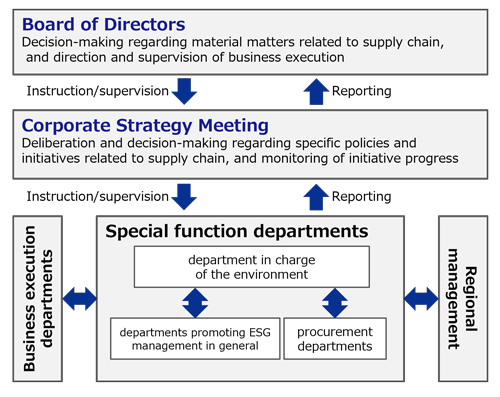 |
The Board of Directors makes decisions on important matters, for instance, management policies, management indicators and targets related to the environment including nature (future-financial targets and indicators), such as the mid-term management plan and support for external initiatives. Each quarter, it provides periodic directions and conducts supervision concerning targets related to environment (future-financial targets and indicators) in the mid-term management Plan as well as the status of progress toward target achievement, and, as necessary, adds new items to the agenda if a material matter arises.
The Board of Directors is comprised of Directors who possess qualifications, knowledge, and experience related to sustainability including nature, and who thus impart it with a sustainable and greater supervisory function. Please refer to the following for information on the skills of directors.
Policies related to the Board of Directors (members) and the Board of Corporate Auditors (members) Nitto Group Integrated Report 2025(P.59 Skills Matrix)At the Nitto Group, we have adopted a compensation system that links remuneration to performance, on the premise that management, including directors and executive officers, is accountable for their respective roles and performance responsibilities. As a medium- to long-term incentive, we have introduced performance-linked restricted share remuneration, which is calculated based on performance and ESG initiative results during a specified evaluation period and the shares are released upon retirement with the restrictions lifted. This performance-linked restricted share remuneration is designed to vary within a range of 0% to 150% depending on the evaluation results, and the evaluation indicators incorporate not only financial metrics such as consolidated operating profit, operating profit margin, and consolidated ROE, but also ESG initiatives results, including responses to climate change. The evaluation ratio for ESG initiatives results is set at 30% of the total.
The Corporate Strategy Meeting is responsible for deliberation and decision-making regarding specific policies and measures for action based on management policies and management indicators regarding the environment including nature. It also manages risks and opportunities across the value chain arising from dependencies and impacts and monitors progress towards achieving targets on a monthly basis. It provides periodic reports on a quarterly basis to the Board of Directors on its deliberations and decisions and the progress of initiatives, and, as necessary, provides additional reports if a material matter arises. Additionally, to ensure that the matters deliberated and decided are promptly disseminated throughout the company, the Corporate Strategy Meeting comprises all Vice Presidents who are in charge of business execution departments, special function departments, and regional management.
We have appointed a Vice President in charge of promoting environmental initiatives including nature, and also have a special function department responsible for implementing those initiatives that serves as the department in charge of the environment. The department regularly assesses dependencies and impacts as well as risks and opportunities on nature, considers strategies, and executes and promotes measures to tackle nature-related issues. The Vice President manages the results of these assessments, the details of their consideration, and their implementation and promotion. In addition, the progress of these initiatives is periodically reported to the Corporate Strategy Meeting primarily by the department in charge of the environment.
The Group identifies the dependencies and impacts on nature, and appropriately manages nature-related key risks and opportunities that management recognizes may significantly impact its business activities. Additionally, we implement comprehensive management across the Group by combining them with other key risks that also significantly impact our business activities.
We assess and identify the importance of business dependencies and impacts on nature, as well as related risks and opportunities in our business activities, and determine priorities. The LEAP approach is used for assessment and identification. Details on the process is as follows: Also, the current assessment scope is limited to the Nitto Group’s manufacturing sites and the upstream portion of the value chain for certain products that are considered to have relatively high dependence or impact on nature.
1. Identification of priority locations (Locate)
Regarding manufacturing sites, we identified sensitive locations from the perspectives of “Biodiversity importance,” “Ecosystems integrity,” “Importance of ecosystem service,” as well as “Water stress and drought risk” and “Impact on indigenous peoples.” We designated sites strongly connected to nature or local communities as material locations. Areas where sensitive locations and material locations overlap are particularly identified as key priority locations (described later as priority locations). (Tools used: Aqueduct, iBAT, and Global Forest Watch)
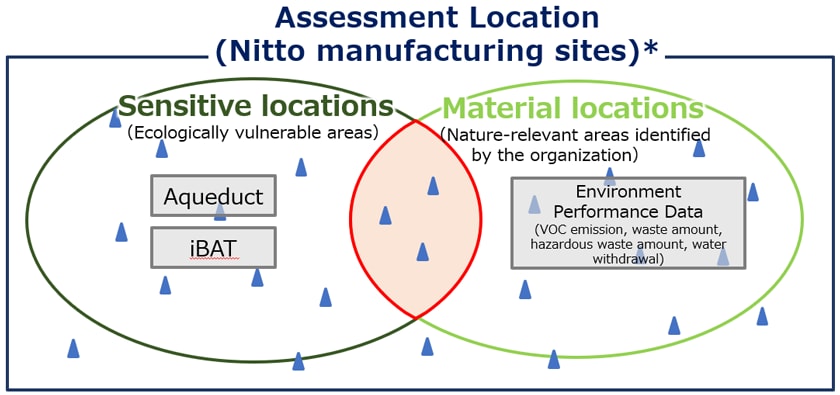 *The Nitto Group considers manufacturing sites to be the main sources of environmental impact, and therefore focuses on those sites. |
2. Evaluation and identification of dependencies and impacts (Evaluate)
We investigated the activities of our manufacturing sites located in priority locations, assessed our dependencies and impact on nature using actual environmental performance data, and conducted a relative evaluation based on the “extent” of these dependencies and impacts as well as their “ likelihood of occurrence” in priority locations to identify the dependencies and impacts relevant to our company.
3. Assessment and identification of risks and opportunities (Assess)
Regarding the risks and opportunities assumed to arise from the identified dependencies and impacts, we assess and identify their relative importance by understanding how changes in the internal and external environment will affect our company, assessing the “degree of impact” on business if such events occur, and the “likelihood of occurrence,” while also determining the priority of these risks and opportunities. Additionally, when identifying risks and opportunities, we utilize scenario analysis to understand those related to the environment, including nature, and assess their potential financial impacts.
We evaluated (using LIME3 calculated from the LIME3 Integration Factor in IDEA v3.3) and selected raw materials assumed to have a significant impact on nature for certain products. We identified sensitive locations for major suppliers’ manufacturing sites of the selected raw materials from the perspectives of the “Biodiversity importance,” “Ecosystems integrity,” “ Importance of ecosystem service,” as well as “Water stress and drought risk.”
(Tools used: Aqueduct, iBAT, and Global Forest Watch)
We understand the impact on our company regarding the dependencies on and impacts over nature, as well as related general risks and opportunities, at the manufacturing sites of suppliers located in sensitive locations. We will have our initiatives on engaging with our suppliers on nature-related issues, working to identify material locations, assess and identify supplier-specific dependencies on and impacts on nature, and strive to understand, evaluate, and identify the associated risks and opportunities for our company. In addition, the main risks and opportunities identified in addressing climate change issues (TCFD) are also managed as environment-related risks and opportunities, including those related to nature.
The Nitto Group appropriately manages the identified major risks and opportunities associated with environment issues including nature under the Risk Management Promotion System below.
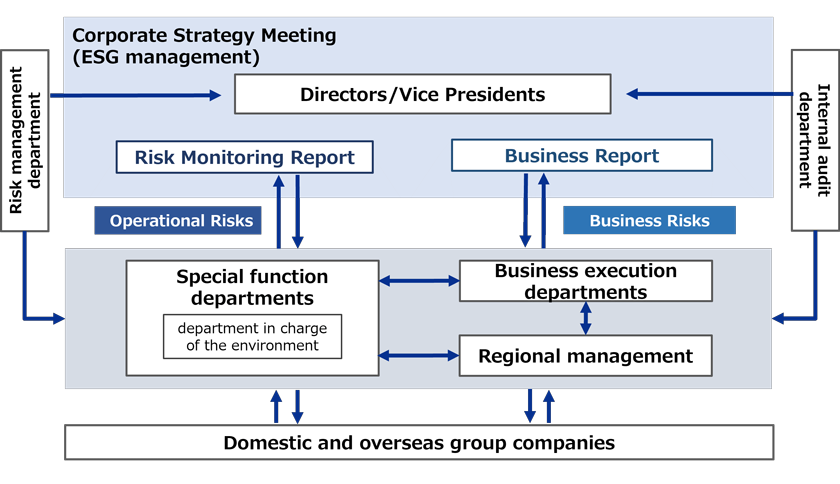 |
The key risks and opportunities related to the environment issues including nature will be monitored by business execution departments and regional management teams in collaboration, while the department responsible for environmental issues will assume responsibility for managing them.
Information regarding monitored risks, together with information managed by other special function departments, will be reported and deliberated monthly at the Corporate Strategy Meeting, which consists of Directors and Vice Presidents.
The results of the deliberations will be instantly instructed to each responsible department and countermeasures will be promptly taken to strengthen controls. The progress of the implementation and improvement will be again reported to the Corporate Strategy Meeting to increase the effectiveness of the Group management.
At the end of the fiscal year, the department in charge of the environment, as the department responsible for the environment management, conducts a self-evaluation on the major risks associated with the environment issues including nature that were reported and reviewed in the Corporate Strategy Meeting in accordance with evaluation criteria such as the implementation structure establishment, controls and preventative measures implementation, and the occurrence of incidents as well as the responses to them. The department in charge of risk management evaluates the results of the self-evaluation from an independent viewpoint. The risk management department and the Vice President in charge of risk management independently conduct evaluations based on established criteria and report the results to the Corporate Strategy Meeting and the Board of Directors.
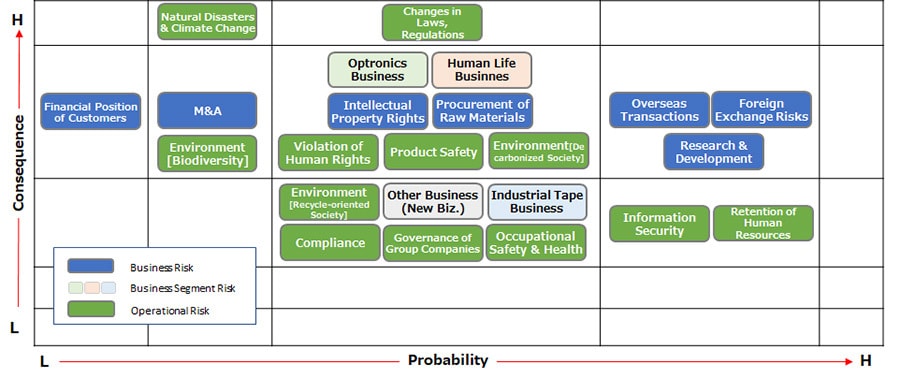
As a group, we manage risks and opportunities related to the environment issues including nature comprehensively by integrating them with other major risks that significantly impact our business operations. We assess the relative importance of individual risks by analyzing them using a graph with two axes––a vertical axis representing the “degree of impact” on our business in case of occurrence or manifestation, and a horizontal axis representing the “probability of occurrence”––and recognize the significance of nature related risks among group-wide risks. We categorize these group-wide risks into “business risks,” which are associated with our businesses, and “operational risks,” which can generate group-wide impact, and implement appropriate risk management on a group basis. The major group-wide risks in fiscal 2025 are as follows. Please see here for more details.
Risk map of the current fiscal year
 |
The Nitto Group aims to achieve nature positivity by not only understanding the impacts on its business from major environmental risks and opportunities, including those related to nature, but also by identifying and taking measures to address its own dependencies and impacts on nature through its business activities. In addition, we recognize “responding to climate change,” “realizing a circular society,” and “conserving biodiversity” as key management issues and are strategically incorporating them into our management practices.
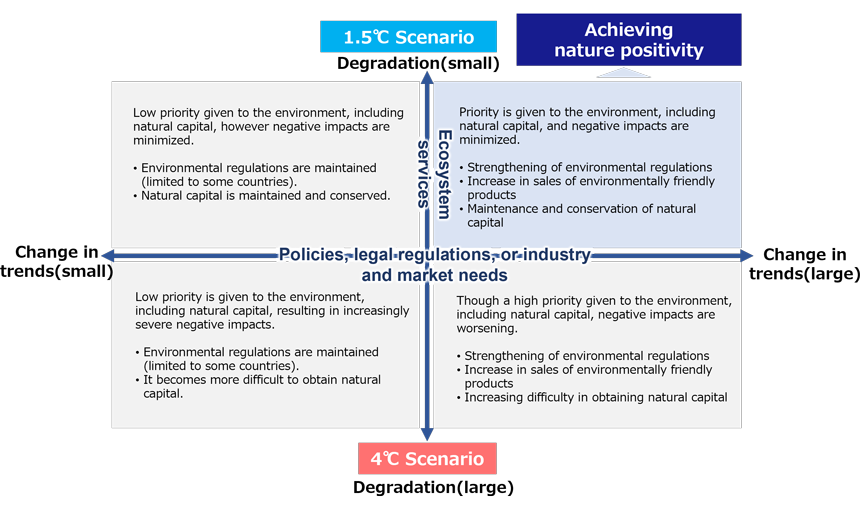
We are developing scenarios that envision the potential states of the world related to “ecosystem services,” which are closely linked to physical risks affecting business activities, and “policies, legal regulations, or industry and market needs,” which are closely associated with transition risks.
Looking ahead to 2050, we are considering the situations shown in the diagram below: one where there is a high priority on nature (with growing trends in policies, regulations, or industry and market needs) and where the degradation of ecosystem services is minimized, and another where there is a low priority on nature (with little to no change, or even a decline, in such trends) and where the degradation of ecosystem services is significant.
Furthermore, we believe that a situation where the degradation of ecosystem services is minimized closely resembles the 1.5°C scenario for climate change, as this situation stems from significantly reduced greenhouse gas emissions, leading to a slower progression of climate change and reduced impact on nature. On the other hand, when there is significant degradation of ecosystem services, we consider it to closely resemble the 4°C climate change scenario, as this situation both results from a lack of reduction in greenhouse gas emissions and the intensification of abnormal weather and natural disasters, thus leading to more serious impacts on nature.
 |
We have identified potential dependencies and impacts on nature at Nitto Group’s manufacturing sites in priority locations.
| Expected changes in nature | |||||||
|---|---|---|---|---|---|---|---|
| Occurrence and intensification of natural disasters | Degradation of ecosystems | Changes in the living environment of local residents | Sea level rise | Decline in soil and water purification functions | Salinization of groundwater | ||
| Dependence | Land use | very low | |||||
| Water resource utilization (groundwater and surface water) | medium | medium | very low | ||||
| Impact | GHG emissions | medium | low | low | low | ||
| Air pollution | low | low | |||||
| Water pollution | low | low | |||||
| Soil pollution | very low | very low | |||||
| Noise and light pollution | very low | ||||||
| Waste emission (landfill/incineration) | medium | ||||||
The degree of dependence and impact of each item is relatively compared as very high, high, medium, low, very low.
In business activities, potential dependencies and impacts related to water resource utilization, GHG emissions, air pollution, water pollution, soil pollution, noise and light pollution, and waste emissions (landfill/incineration) have been identified. Among these, it was suggested that there is a certain degree of dependence and impact on factors such as “ecosystem degradation” and “decline in water purification functions” due to water resource utilization, “occurrence and intensification of natural disasters” due to GHG emissions, and “changes in the living environment of local residents” due to waste discharge (landfill/incineration).
We identify the dependencies and impacts on nature, as well as the risks and opportunities in the short-term (less than three years), medium-term (three to five years), and long-term (five years or more) under the business environment assumed in the respective scenarios.
The short-term and medium-term risks and opportunities are reflected in the medium-term management plan. For the long-term risks and opportunities, we conducted a qualitative analysis to identify the business impact (financial impact) in the event that the respective scenarios materialize. The business impacts in the medium and long term are as follows.
| Types of risks and opportunities | Events | Value chain | Assumed risks and opportunities | Degradation
(small) Trend Change (strong) Year 2030 |
Degradation
(small) Trend Change (strong) Year 2050 |
Degradation (large)
Trend Change (weak) Year 2030 |
Degradation (large)
Trend Change (weak) Year 2050 |
|
|---|---|---|---|---|---|---|---|---|
| Transition risk | Policy and Legal regulations | Stricter nature-related regulations | Our company | Increase in operational costs due to strengthened water intake regulations | - | Low | - | - |
| Transition risks | Policies and Laws and regulations | Stricter nature-related regulations | Our company | Increase in tax (operational) costs due to tighter regulations on the emission of air pollutants | Low | Low | - | - |
| Transition risk | Policy and Laws and regulations | Strengthening of waste regulations | Our company | Increase in waste disposal costs due to stricter waste disposal regulations and standards | Medium | Medium | - | - |
| Transition risk | Industry/market | Soaring fossil fuel prices | Upstream | Increased procurement costs of petroleum-derived raw materials due to soaring fossil fuel prices | - | - | High | High |
| Physical risk | Chronic | Decrease in natural capital | Our company | Decrease in production capacity due to water resource reduction (difficulty in ensuring supply) | - | Low | Low | Medium |
| Opportunity | Product/Service | Increasing demand for products that contribute to the environment | Our company | Increase in sales of membrane products due to rising demand for water recycling products | Medium | Medium | Low | Medium |
| Opportunity | Product/Service | Increasing demand for products that contribute to the environment | Our company | Increase in sales of low-VOC products due to changes in customer preferences | Low | Low | - | - |
| Opportunity | Product/Service | Increasing demand for products that contribute to the environment (Response to waste disposal) | Our company | Increased sales of recycled products as a response to waste disposal requirements | Low | Low | - | - |
| Opportunity | Product/Service | Increasing demand for products contribute to the human life
(Response to infectious diseases) |
Our company | Increase in sales of medical-related products due to growing health damage from air and water pollution | - | - | Low | Low |
Describes the “degree of impact” on the business if an event occurs multiplied by the “likelihood of occurrence,” using high, medium, or low. The mark (-) assumes that the financial impact is extremely small.
When priority is given to nature and the negative impact is minimized, the following become the main causes of financial impact.
Negative financial impactWhen the priority on nature is low and the negative effects have become more severe, the following factors are the main drivers of financial impact.
Negative financial impactFor other risks and opportunities anticipated from GHG emissions and corresponding responses, please refer to the Nitto Group’s response to climate change issues (Disclosure Based on TCFD Recommendations).
We examined measures to address risks and opportunities in each scenario.
In a state where nature is given high priority and negative impacts are minimized,
We believe that these efforts can help control the increase in operating costs due to key site, Increase in tax (operational) costs due to stricter regulations on the emission of air pollutants, and the increase in waste disposal costs due to stricter waste disposal regulations and standards
In situations where the priority for nature is low and negative impacts are becoming serious,
Through these initiatives, we believe it is possible to mitigate the increased procurement costs of petroleum-derived raw materials due to soaring fossil fuel prices, as well as decrease in production capacity due to water resource reduction (difficulty in ensuring supply).
*Key sites: Manufacturing sites identified as critical, located in sensitive locations or material locations respect to water utilization and VOC emissions.
In a state where the priority given to nature is high and negative impacts are minimized, we are working to expand products that contribute to the environment (PlanetFlags™ certified products) in order to maximize opportunities, and we expect increased sales of products such as membrane products, low-VOC products, and recycled products.
In a situation where the priority given to nature is low and negative impacts are worsening, we are working to expand products that contribute to humanity (HumanFlags™ certified products), and we expect an increase in sales of medical-related products due to the rise in health issues associated with air and water pollution.
We believe that by continuously creating PlanetFlags™ and HumanFlags™, we can ensure a certain level of profit.
For more details about PlanetFlags™ and HumanFlags™, please refer here.
The Group has “responding to climate change,” “realizing circular society,” and “conservation of biodiversity” as material issues for sustainability and is promoting initiatives to address natural-related issues.
In addition, the Group ensures that the countermeasures are implemented to minimize risks and maximize opportunities and has established 2030 management indicators and targets to regularly monitor and manage the progress of those countermeasures. In order to achieve our ideal state through the resolution of Material Issues for Sustainability, the Nitto Group as a whole has established “Resource utilization ratio” “Water recycled volume at a priority site” “Recycled water utilization ratio in the manufacturing processes at a priority site” “VOC emissions at a priority site” “Sustainable materials procurement ratio” and “Flags revenue ratio” as materiality KPIs.
Although we have previously focused on improving our waste plastics recycling ratio, given that plastics account for roughly half of our total waste, we newly introduced the “Resource utilization ratio,” in the fiscal 2025, to promote the active circular use of a broader range of resources beyond plastics.
Furthermore, from the perspectives of water stress and drought risk, we identified priority sites that should preferentially work on reducing water withdrawals and promoting water recycling, and set targets —at least 420 kt/year for “Water recycling volume at a priority site (Kameyama site),” and 100% target for “Recycled water utilization ratio in the manufacturing processes at a priority site (Shiga site).” Moreover, based on actual VOC emissions, we identified priority sites that should work on VOC reduction and set a target of at least 70% reduction (compared to FY18) target in “VOC emissions at a priority site (Nitto Bento Bantçilik San. ve Tic. A.Ş.).”
The indicators and targets for each dependency, impact, and risk/opportunity by 2030 are as follows.
| Types of risk/ opportunity | Assumed dependencies and impacts | Value chain | Assumed
risks and opportunities |
Countermeasures | Indicators | FY2030 Target |
|---|---|---|---|---|---|---|
| Transition risk | Water resource utilization
(Groundwater and surface water) |
Our company | Increase in operational costs due to strengthened water intake regulations | Improving water use efficiency | Water recycling volume at a priority site (Kameyama site)
Recycled water utilization ratio in the manufacturing processes at a priority site (Shiga site) |
420kt or more/year
100% |
| Transition risk | Air pollution | Our company | Increase in tax (operational) costs due to tighter regulations on the emission of air pollutants | Reduction of VOC emissions
Proper management of VOC emissions Proper management of other air pollutants |
VOC emissions at a priority site (Nitto Bento Bantçilik San. ve Tic. A.Ş.) | 70% or more reduction (compared to FY18) |
| Transition risk | Waste emissions (landfill/incineration) | Our company | Increase in waste disposal costs due to stricter waste disposal regulations and standards | Promotion of the 3Rs of waste (Reduce, Reuse, Recycle)
Efficient use of resources |
Resource utilization ratio | 69% or more |
| Transition risk | GHG emissions | Upstream | Increased procurement costs of petroleum-derived raw materials due to soaring fossil fuel prices | Transition from petroleum-derived raw materials to sustainable materials (biomaterials/recycled materials)
Reduction of raw material purchase and usage amounts. |
Sustainable materials procurement ratio
Resource utilization ratio |
30% or more
69% or more |
| Physical risk | Water resource utilization
(Groundwater and surface water) |
Our company | Decrease in production capacity due to water resource reduction (difficulty in ensuring supply) | Improving water use efficiency | Water recycling volume at a priority site (Kameyama site)
Recycled water utilization ratio in the manufacturing processes at a priority site (Shiga site) |
420kt or more/year
100% |
| Opportunity | Use of water resources
(Groundwater and surface water) GHG emissions Waste emissions (landfill and incineration) |
Our company | Increase in sales of membrane products due to rising demand for water recycling products
Increased sales of low VOC products due to changes in customer preferences Increased sales of recycled products as a response to waste disposal requirements |
Expansion of PlanetFlags™ certified products | Flags revenue ratio | 50% or more |
| Opportunities | Air pollution
Water pollution |
Our company | Increase in sales of medical-related products due to growing health damage from air and water pollution | Expansion of HumanFlags™ certified products | Flags revenue ratio | 50% or more |
We enhance the feasibility of the indicators and targets for each dependency, impact, risk, and opportunity by not only implementing management on a group level, but also by allocating group targets to the business execution departments, setting individual targets for each business execution department, and developing business-specific measures in addition to group-wide measures. Each business execution department confirms the progress achievement toward key targets including future-financial targets monthly; the department in charge of the environment manages the progress on a group-wide basis and provides a report to the Corporate Strategy Meeting. The indicators and targets are reviewed once a year to make any necessary revisions depending on the progress status or changes in the external environment. Further, the future-financial indicators are reviewed when we update the mid-term management plan once every three years, and revisions are made following review and decision by the Board of Directors.
For initiatives and achievements related to the Resource utilization ratio, Sustainable materials procurement ratio, and the Flags revenue ratio, please refer to the Nitto Group’s Response to Climate Change.
In fiscal 2025, recycled water utilization ratio in the manufacturing processes at a priority site (Shiga site) reached 83%.
By utilizing water treatment technology that uses the Nitto Group’s reverse osmosis (RO) membranes, we are promoting the reuse of wastewater and waste liquids generated at our business sites.
Going forward, by further promoting water reuse in manufacturing processes, we will strengthen our response to water-related risks while achieving both reduced dependence on water intake (reduced water withdrawal) and stable operations, and work to enhance business resilience under abnormal weather conditions.
| Indicator | FY2024 | FY2025 | FY2030 Target |
|---|---|---|---|
| Recycled water utilization ratio in the manufacturing processes at a priority site (Shiga Site) | - | 83% | 100% |
In fiscal 2025, water recycled volume at a priority site (Kameyama site) reached 154kton.
| Indicator | FY2024 | FY2025 | FY2030 Target |
|---|---|---|---|
| Water recycling volume at a priority site (Kameyama Site) | - | 154kton | 420kt or more/year |
In fiscal 2025, VOC emissions at a priority site (Nitto Bento Bantçilik San. ve Tic. A.Ş.) were reduced 74%.
In fiscal 2025, we continued to promote solvent-free initiatives through the use of solvent-free UV-curable adhesives and water-based adhesives.
Going forward, by promoting the reduction of hazardous substance use based on voluntary management standards, we will further reduce VOC emissions and strive to minimize impacts on the environment surrounding our business sites and on employees’ health.
| Indicator | FY2024 | FY2025 | FY2028 Target |
|---|---|---|---|
| VOC emissions at a priority site (Nitto Bento Bantçilik San. ve Tic. A.Ş.) | - | 74% | 70% or more reduction (compared to FY18) |
Aiming to achieve nature positivity, we will identify our dependence and impact on nature in business activities, prioritize risks and opportunities, and implement actions toward achieving our targets. Furthermore, regardless of the degree of dependence and impact on, or the scale of risks and opportunities related to nature, we consider it the responsibility of a company to minimize negative impacts on nature, and we are studying countermeasures accordingly.
In the upstream in the value chain, we do our efforts to engage with suppliers on nature-related issues and strive to understand the impacts that suppliers’ unique dependence on and impact over nature have on our company and to assess and identify the importance of those matters. In addition, we plan to expand the range of target products and move forward with identifying raw materials that are expected to have a large dependence and impact on nature. In the downstream of the value chain, we recognize the “increase in operating costs due to the reinforcement of producer responsibility regulations” as a risk that is expected to affect business activities. Currently, we believe that the impact on business activities is extremely small, but we will continue to closely monitor the influence of external environmental changes on our business operations.
